
Research
Work Expands to Fill the Time
Parkinson’s Law, workload and deadline habits among young Malaysian students: a practice-copy study, using sample data.
- Asyraf Razali

Practice copy. Every figure, table and statistic in Sections 4 to 6 is sample data for rehearsal. It is not from a real survey. Read this paper as an illustration of a method, not as findings.
Full title: Work Expands to Fill the Time: Parkinson’s Law, Workload and Deadline Habits among Young Students of the Faculty of Information Science, UiTM Rembau.
Asyraf Razali, Diploma in Information Management, Faculty of Information Science, Universiti Teknologi MARA (UiTM), Negeri Sembilan Branch, Rembau Campus. Written on 5 October 2026. Published on Vorscorp with the author's permission. UiTM is named as the author's place of study; this is not a UiTM publication.
Abstract
Parkinson’s Law, the principle that work expands to fill the time available, is usually told as a joke, yet it describes a measurable pattern in student life. This study examines how deadline length and concurrent workload relate to when young Malaysian undergraduates begin assignments, how many hours they invest, and which information tools they use to track deadlines. A cross-sectional survey was administered to [N] students of the Faculty of Information Science, UiTM Negeri Sembilan, Rembau Campus. Data were analysed using descriptive statistics, Spearman correlation, Mann-Whitney U and Kruskal-Wallis tests, with reliability checked using Cronbach’s alpha. In the sample data used in this practice copy, longer deadlines were associated with later starts (ρ = 0.61) but only modestly more effort (ρ = 0.29), and workload was associated with differences in start behaviour (H = 9.72, p = 0.008). The paper proposes a “Parkinson-proofing” model that combines self-imposed shorter deadlines, staged checkpoints and personal information management practices, and offers separate recommendations for students and lecturers. Because the sample is small and drawn from a single campus, findings are exploratory.
Keywords: Parkinson’s Law, academic procrastination, student syndrome, deadlines, workload, personal information management, Malaysian youth, UiTM
1. Introduction
1.1 Background
In 1955, C. Northcote Parkinson wrote that work expands so as to fill the time available for its completion (Parkinson, 1955). He was describing bureaucracies, but anyone who has lived through a semester recognises the pattern: a two-week assignment takes two weeks, whether the real effort needed is two days or ten.
A related idea from project management is the student syndrome, in which people postpone starting a task until the last possible moment, even when they have ample time (Goldratt, 1997). Together the two ideas make a strong claim: time given is not the same as time used well.
1.2 Why this matters for Malaysian youth
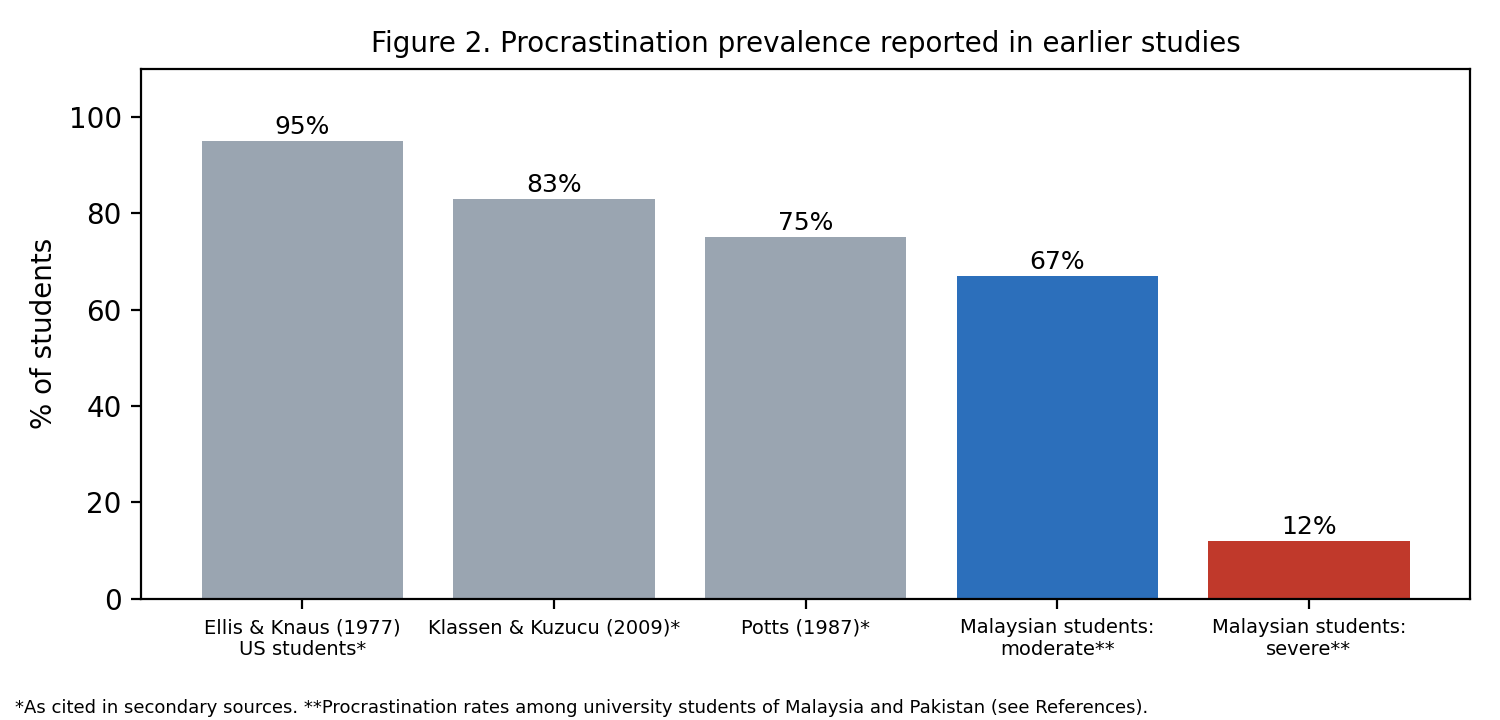
Malaysian law currently defines youth as persons aged 15 to 30 (Youth Societies and Youth Development (Amendment) Act 2019), which covers most undergraduates. Prior Malaysian studies suggest that delay is widespread: a comparative study of university students found that about 67% of Malaysian respondents showed moderate procrastination and about 12% showed severe procrastination (Kosnin & Khan, 2016), and a 2025 study of 284 students from public and private universities reported moderate procrastination overall, with amotivation as a significant positive predictor (Wei & Mohd Noordin, 2025). These studies mostly use psychology or education samples. Few examine information science students, who are taught to organise information professionally yet face the same temptation to delay.
1.3 Research context
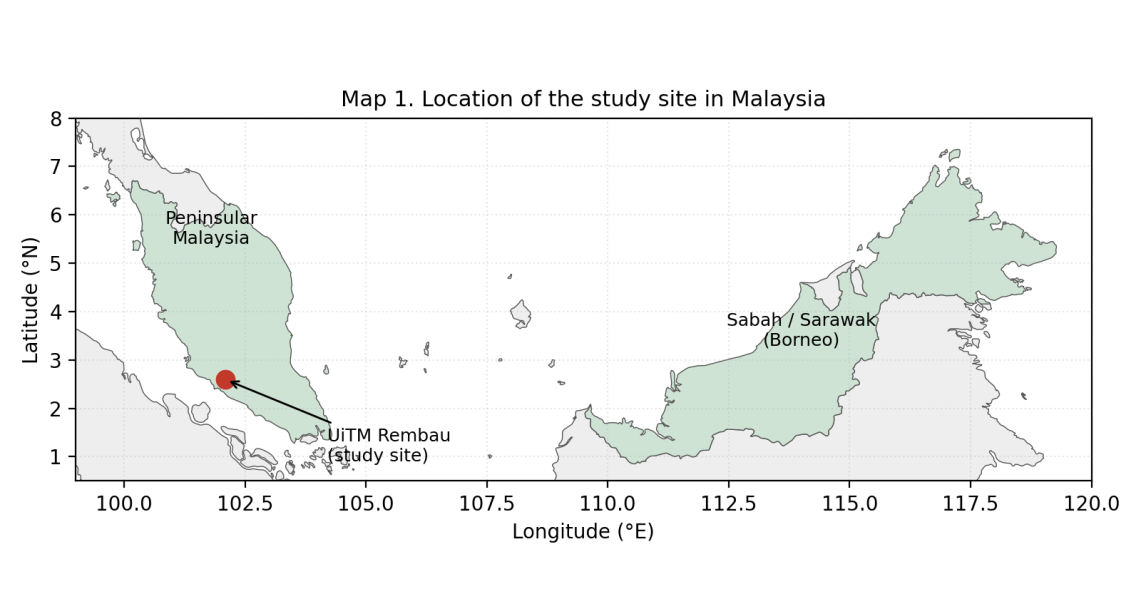
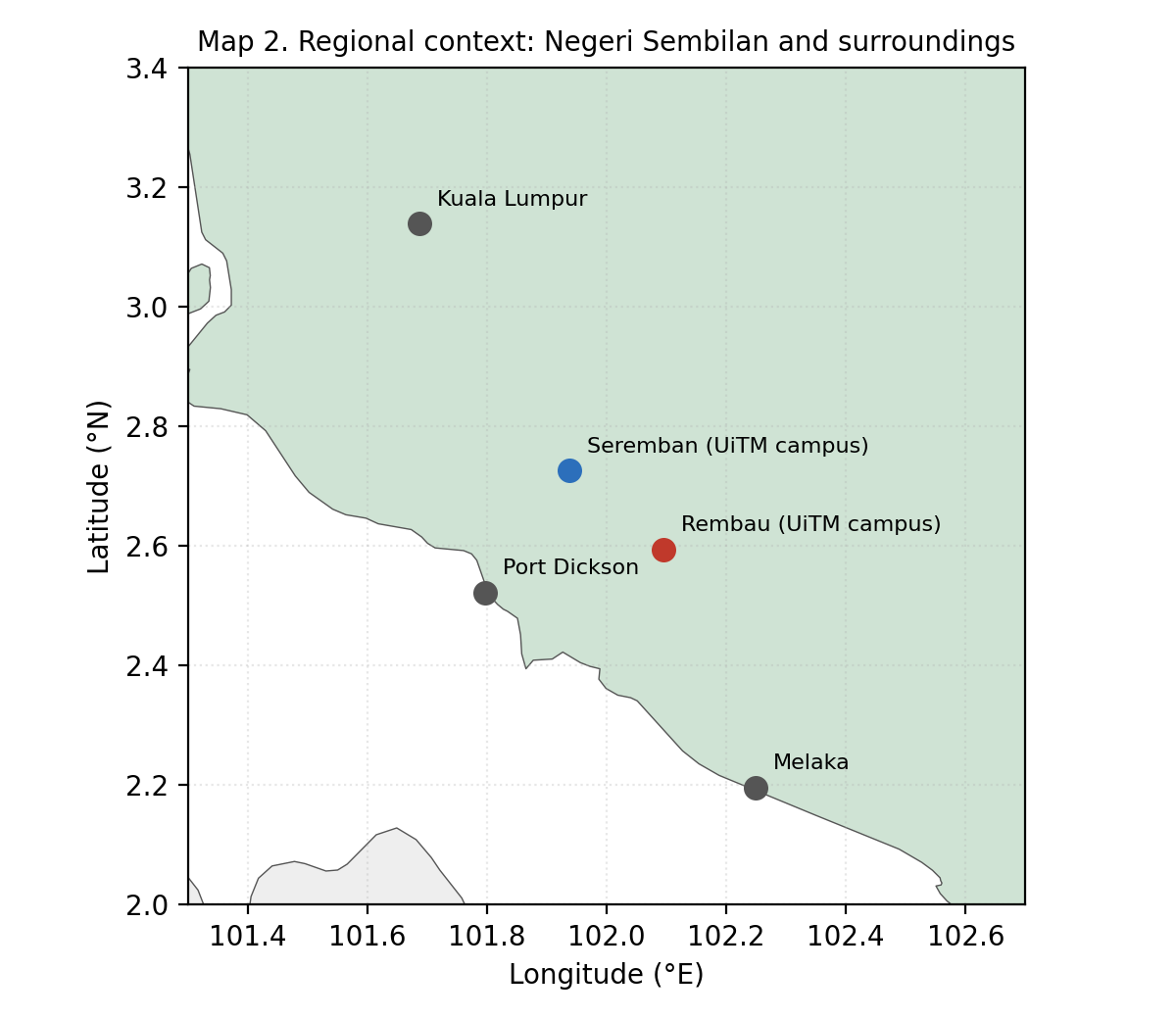
UiTM Negeri Sembilan Branch operates two campuses, Seremban and Rembau. The Rembau campus (Jalan UiTM Rembau, 71300 Rembau, Negeri Sembilan) hosts the Information Science programme studied here. Its semi-rural setting, mixed hostel and off-campus residence, and heavy reliance on WhatsApp and the learning management system for coursework make it a useful micro-context for studying deadline behaviour.
1.4 Problem statement
Lecturers often assume that longer deadlines or generous workloads help students manage time. If Parkinson’s Law holds, extra time may produce later starts rather than better work, and heavy workloads may intensify the effect.
1.5 Research questions
- RQ1: When do Information Science students at UiTM Rembau typically start assignments?
- RQ2: Is deadline length associated with later start times and with hours of effort?
- RQ3: Does the number of concurrent assignments change this pattern?
- RQ4: Which information tools are used for tracking deadlines, and are they associated with earlier starts?
1.6 Hypotheses
- H1: Longer deadlines are associated with later start timing (as a proportion of the time available).
- H2: Hours spent do not increase proportionally with deadline length.
- H3: Students with more concurrent assignments start later on average.
- H4: Students who break tasks into self-set dates start earlier than those who do not.
1.7 Significance
For students, the study offers practical habits. For lecturers and programme coordinators, it offers evidence for designing deadlines. For information professionals, it links personal information management to academic outcomes.
2. Literature Review
2.1 Parkinson’s Law and the student syndrome
Parkinson (1955) proposed that effort expands to match available time. Goldratt (1997) later described the student syndrome in project scheduling: safety time is wasted because work begins late, then is rushed. Both predict that a longer deadline mostly shifts the start date.
2.2 Prevalence of academic procrastination
Evidence consistently shows high rates. Reviews report that roughly 80 to 95% of college students engage in some procrastination (Steel, 2007), and early studies found that nearly half of students reported procrastinating on writing term papers (Solomon & Rothblum, 1984). Estimates across studies vary widely, from about 20% to 90% depending on the definition and instrument used.
2.3 Causes: self-regulation, motivation and mood
Procrastination is linked to weak self-regulation (Steel, 2007) and to short-term mood repair, where students avoid unpleasant tasks to feel better now (Sirois & Pychyl, 2013). In a Malaysian sample of 287 private-university undergraduates, self-regulation and procrastination were studied together (see Jurnal Psikologi Malaysia, listed in references), and Malaysian findings on motivation show amotivation predicts delay (Wei & Mohd Noordin, 2025). Qualitative work describes procrastination as a mix of fear of failure, task aversion and poor time use (Schraw, Wadkins, & Olafson, 2007).
2.4 Deadlines as a self-control tool
Ariely and Wertenbroch (2002) showed in experiments that people who set their own evenly spaced deadlines performed better than those with a single final deadline, but worse than those given externally imposed even deadlines. This supports using staged, binding checkpoints.
2.5 Planning fallacy
People systematically underestimate how long tasks will take (Buehler, Griffin, & Ross, 1994). A long deadline therefore feels generous and encourages delay.
2.6 Implementation intentions
Gollwitzer (1999) found that specifying when, where and how one will act (“If it is Tuesday 8 pm, I will open the proposal file in the library”) substantially increases follow-through. This is a practical antidote to open-ended time.
2.7 Consequences
Procrastination is associated with lower well-being and performance. A recent systematic review reported that every included study found a significant positive relationship between academic procrastination and suicidality, with correlations ranging from 0.19 to 0.51 (see European Psychiatry, 2025, in references). This is not a claim that late starts cause serious harm in most students, but it shows why the topic deserves attention.
2.8 Personal information management (PIM)
PIM concerns how people keep, organise and re-find information for everyday tasks (Jones, 2007). Deadlines are information items: if they are scattered across chat groups, announcements and memory, they are harder to keep visible.
2.9 Research gap
Malaysian studies tend to treat procrastination as a psychological trait. Fewer treat it as an information and workload design problem, or study Information Science students on a single campus, and none known to the author combine deadline length, concurrent workload and tracking tools.
2.10 Conceptual framework
- Deadline length: influences start timing.
- Concurrent workload: influences start timing.
- Tracking tools and planning habits: influence start timing.
- Start timing: shapes hours of effort and self-rated preparedness.
- Hours of effort and preparedness: shape perceived quality and stress.
Figure 1. Proposed relationships. Deadline length, workload and planning habits are expected to influence when students start, which in turn shapes effort, preparedness and stress.
3. Methodology
Design. Quantitative, cross-sectional, descriptive-correlational survey with one open-ended item.
Population and sample. Undergraduate students of the Faculty of Information Science, UiTM Negeri Sembilan, Rembau Campus. Convenience sampling via class groups; target n ≥ 50 [actual N = 50]. A sample this size can detect only medium-to-large effects, so findings are treated as exploratory.
Instrument. Google Forms questionnaire in five parts: (A) demographics and context, (B) deadlines and workload, (C) start behaviour, (D) tracking tools, (E) Likert statements (1 to 5). Optionally adapt items from Tuckman’s (1991) Procrastination Scale; check the permission and licensing terms before reuse.
Variables
- Deadline length (ordinal or numeric): days given (Q3, Q7, Q8).
- Concurrent assignments (numeric): number due within the same 2 weeks.
- Start ratio (numeric): days elapsed before starting ÷ total days given (0 = immediate, 1 = at deadline).
- Hours spent (numeric): self-reported.
- Tracking tool (nominal): multiple response.
- Planning habit (ordinal): Q10.
- Preparedness and efficiency attitudes (Likert): Q11 to Q15.
Procedure. Survey open for 7 days; consent obtained on the first page; responses anonymous.
Analysis plan
- Overall profile: frequencies, mean, median, SD, to describe the data.
- Scale reliability: Cronbach’s alpha (target ≥ 0.70), to check Likert consistency.
- H1, deadline vs start ratio: Spearman’s rho, for ordinal or skewed data.
- H2, deadline vs hours: Spearman’s rho, the same.
- H3, workload vs start: Spearman’s rho or Kruskal-Wallis, to compare groups.
- H4, planning vs start: Mann-Whitney U, for two groups.
- Tool use vs start: chi-square or Fisher’s exact, for categorical data.
Significance level α = 0.05. Report effect sizes (rho, r) alongside p-values. Software: Google Sheets / Excel for descriptives, JASP or SPSS for tests.
Ethics. No identifying information collected; voluntary participation; right to withdraw.
4. Results
PRACTICE COPY: every figure, table and statistic in Sections 4 to 6 is sample data for rehearsal. It is not from a real survey and must be replaced with actual results before this paper is submitted or published.
4.1 Respondent profile
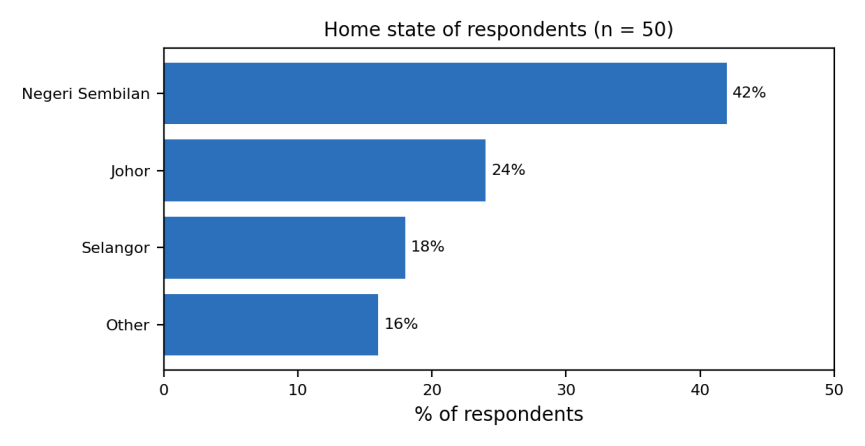
Sample: 50 students; 58% female and 42% male; semester 3 (28%), semester 4 (34%), semester 5 (24%) and semester 6 (14%); 62% living in hostel and 38% off campus. Home states: Negeri Sembilan 42%, Johor 24%, Selangor 18%, other 16%.
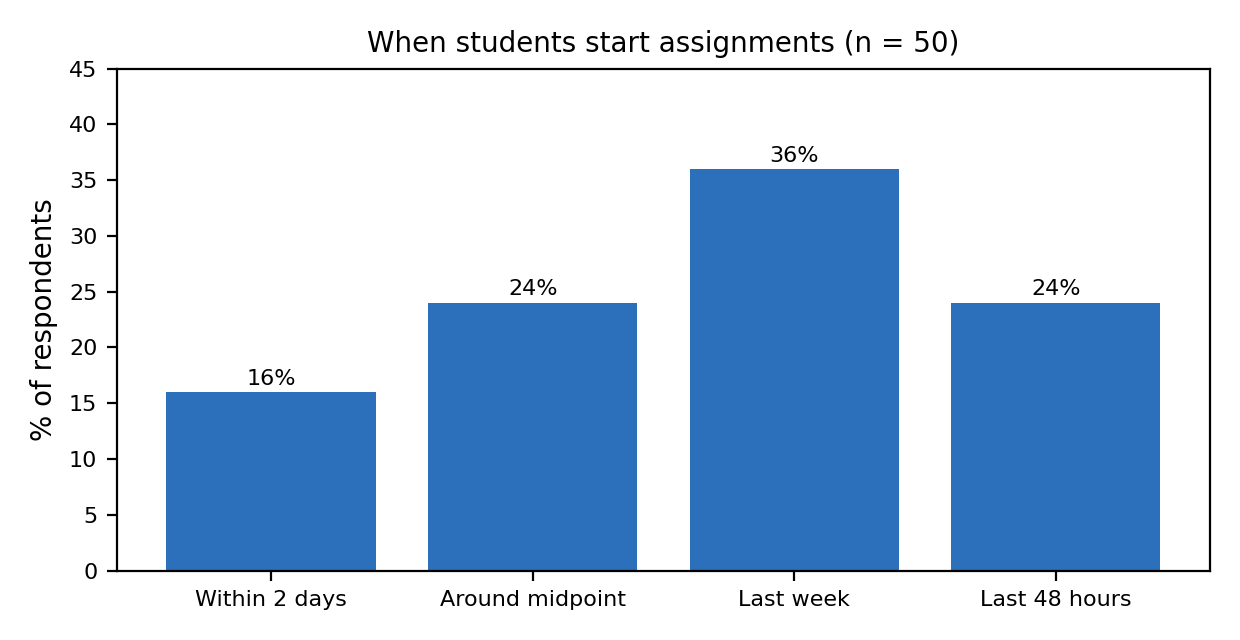
4.2 Start timing (RQ1)
When students started assignments:
- Within 2 days of issue: 8 (16%)
- Around midpoint: 12 (24%)
- Last week: 18 (36%)
- In the last 48 hours: 12 (24%)
4.3 Deadline length, start ratio and effort (RQ2)
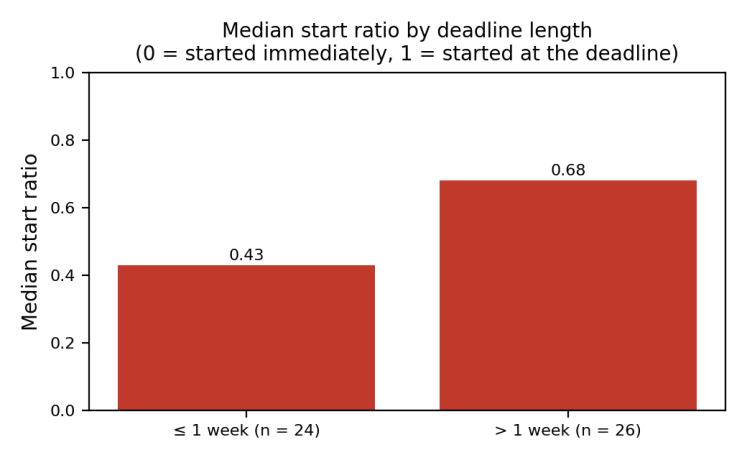
By deadline group:
- 1 week or less (n = 24): median start ratio 0.43, median hours 5.0.
- More than 1 week (n = 26): median start ratio 0.68, median hours 7.0.
Spearman correlations: deadline length vs start ratio ρ = 0.61, p < 0.001; deadline length vs hours spent ρ = 0.29, p = 0.04. The start ratio is the share of the available time that had passed before the student began (0 = started immediately, 1 = started at the deadline), so a higher ratio means a later start.
4.4 Workload (RQ3)
Median concurrent assignments: 4. A Kruskal-Wallis test comparing start ratios across workload groups was significant (H = 9.72, df = 2, p = 0.008).
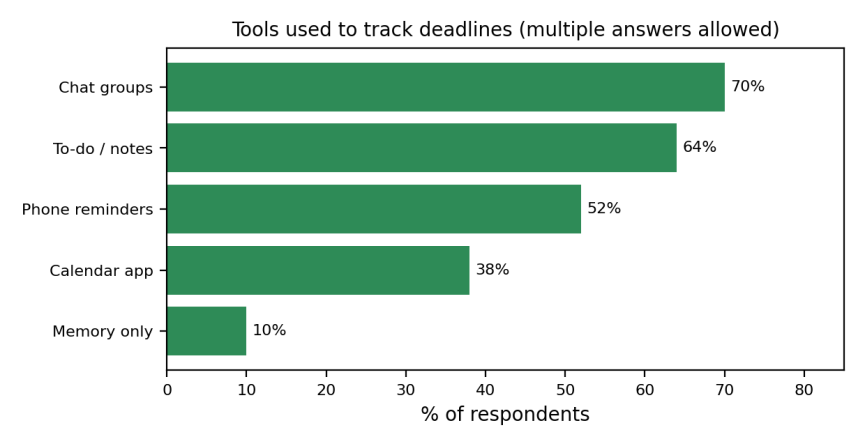
4.5 Tools (RQ4)
Share of students using each tool, with the median start ratio among its users:
- Phone reminders: 52%, median start ratio 0.62.
- Calendar app: 38%, median start ratio 0.66.
- Chat groups: 70%, median start ratio 0.55.
- To-do or notes: 64%, median start ratio 0.59.
- Memory only: 10%, median start ratio 0.42.
4.6 Hypothesis summary
- H1: Yes. ρ = 0.61, p < 0.001 (longer deadlines, later start).
- H2: Partly. ρ = 0.29, p = 0.04; effort rose only modestly.
- H3: Yes. H = 9.72, p = 0.008.
- H4: Not supported. Tool users had higher (later) start ratios than memory-only users.
5. Discussion
5.1 Interpreting the pattern
In the sample data, most students began in the last week or the last 48 hours (60% combined), which fits the pattern Parkinson (1955) and Goldratt (1997) describe. Longer deadlines were associated with later relative starts (ρ = 0.61) but only slightly more hours of work, so extra time was not converted into proportional effort. The tools result is the surprising one: students who relied on memory alone had the earliest median start (0.42), while users of chat groups, to-do lists, reminders and calendars started later. One possible explanation is that passive reminders create a false sense of security, but this needs testing with real data. Severe delay in a real sample should be compared with the roughly 12% reported for Malaysian students by Kosnin and Khan (2016).
5.2 Parkinson’s Law in everyday student life
The law is not only about assignments. Illustrative (hypothetical) examples:
- Two-week individual assignment. How the law shows up: start on day 12, finish on day 14. Parkinson-proof move: set a personal due date on day 9.
- Group project. How the law shows up: everyone waits for “the right time” to meet. Parkinson-proof move: fix the first meeting date at the first lecture.
- Final-year project proposal. How the law shows up: months of reading, little writing. Parkinson-proof move: a weekly 500-word output target.
- Revision for finals. How the law shows up: “I’ll start after the break.” Parkinson-proof move: timebox, 3 sessions of 90 minutes this week.
- Daily routine. How the law shows up: getting ready takes 30 minutes if you have 30, 15 if you have 15. Parkinson-proof move: shorten the allowed time and test it.
5.3 When lecturers give a lot of work
Heavy workloads do not cancel the law; they can strengthen it. With several tasks due in the same window, students tend to pick the nearest deadline and delay the rest, producing a pile-up at the end of the semester. Three mechanisms are plausible: (1) the planning fallacy makes each task look smaller than it is (Buehler et al., 1994); (2) distant deadlines carry little emotional urgency (Steel, 2007); and (3) unclear tracking hides the true load (Jones, 2007). The practical lesson is that the number of deadlines in a given week matters as much as the length of any single deadline.
5.4 The Parkinson-proofing model
- Assignment issued.
- Record it in one trusted tool.
- Set a personal deadline earlier than the official one.
- Split into 3 to 5 sub-tasks with dates.
- Write an if-then plan for the first task.
- Timebox each session.
- Review weekly and adjust.
Figure 6. Parkinson-proofing workflow for students.
5.4.1 For students
- Shrink the time. Give each task a deliberately tight window (for example, 90 minutes). Work then expands to fit a smaller container.
- Create binding checkpoints. Ask a friend to review a draft on a fixed date (Ariely & Wertenbroch, 2002).
- Use implementation intentions. “If it is Wednesday 8 pm, I will write the introduction in the library” (Gollwitzer, 1999).
- Keep one master list. One calendar or notes app, not scattered chats (Jones, 2007).
- Plan for underestimation. Multiply your first time estimate by 1.5 (Buehler et al., 1994).
5.4.2 For lecturers and coordinators
- Stage large assignments with graded checkpoints (outline, draft, final).
- Map the semester’s load. A shared deadline calendar across courses prevents clusters.
- Prefer shorter, firmer windows over open-ended ones when the task allows.
- Make deadlines visible in the learning management system, not only in chat groups.
5.4.3 For information professionals and the library
Offer short workshops on personal information management and task-tracking, extending existing information literacy programmes already delivered to new intake.
5.5 Limitations
Small convenience sample from one campus; self-reported data; cross-sectional design shows association only; some students may deliberately work well under pressure and are not “procrastinating”. Future studies should use larger multi-campus samples, learning-platform submission timestamps, and mixed methods.
6. Conclusion
In the sample data, longer deadlines and heavier workloads were both associated with later starting among Faculty of Information Science students. If real survey data show the same pattern, the study supports treating deadline management as an information-design problem as well as a behavioural one. Time is a resource that expands to fill the container it is given, so students and lecturers can choose smaller, clearer, better-tracked containers.
6.1 Recommendations
Based on the sample pattern, and subject to confirmation with real data:
- Students: set a personal deadline at about 60% of the time available, because the sample suggests the natural start point drifts toward the end. Write the date in one place and add a first concrete task (for example, "write the outline on Tuesday at 8 pm").
- Students: do not rely on reminders alone. A reminder tells you a deadline exists, but it does not start the work. Pair each reminder with a small first action and a person who will check on it.
- Lecturers: replace single long deadlines with two or three staged checkpoints. Longer windows alone were linked to later starts without a matching increase in effort.
- Programme coordinators: publish a shared semester deadline calendar across courses, since higher numbers of concurrent assignments were linked to different start behaviour.
- Faculty and library: run a short workshop on personal information management and timeboxing, building on the information literacy sessions already given to new intakes.
- Future research: replace self-reported start dates with learning-platform submission timestamps, widen the sample to other UiTM campuses, and test whether staged checkpoints reduce last-48-hour starts.
References
Verify each entry against the original source before submitting, and format it to your publisher's required style.
- Ariely, D., & Wertenbroch, K. (2002). Procrastination, deadlines, and performance: Self-control by precommitment. Psychological Science, 13(3), 219–224.
- Buehler, R., Griffin, D., & Ross, M. (1994). Exploring the “planning fallacy”: Why people underestimate their task completion times. Journal of Personality and Social Psychology, 67(3), 366–381.
- Goldratt, E. M. (1997). Critical chain. North River Press.
- Gollwitzer, P. M. (1999). Implementation intentions: Strong effects of simple plans. American Psychologist, 54(7), 493–503.
- Jones, W. (2007). Personal information management. Annual Review of Information Science and Technology, 41(1), 453–504.
- Parkinson, C. N. (1955, November 19). Parkinson’s Law. The Economist.
- Schraw, G., Wadkins, T., & Olafson, L. (2007). Doing the things we do: A grounded theory of academic procrastination. Journal of Educational Psychology, 99(1), 12–25.
- Sirois, F., & Pychyl, T. (2013). Procrastination and the priority of short-term mood regulation. Social and Personality Psychology Compass, 7(2), 115–127.
- Solomon, L. J., & Rothblum, E. D. (1984). Academic procrastination: Frequency and cognitive-behavioral correlates. Journal of Counseling Psychology, 31(4), 503–509.
- Steel, P. (2007). The nature of procrastination: A meta-analytic and theoretical review of quintessential self-regulatory failure. Psychological Bulletin, 133(1), 65–94.
- Tuckman, B. W. (1991). The development and concurrent validity of the Procrastination Scale. Educational and Psychological Measurement, 51(2), 473–480.
- Wei, P. K., & Mohd Noordin, N. (2025). The effect of academic motivation on academic procrastination among undergraduate students in Malaysia. Sains Humanika. https://sainshumanika.utm.my/index.php/sainshumanika/article/view/2246
- Kosnin, A. M., & Khan, M. U. (2016). Procrastination rates and similarities among university students of Malaysia and Pakistan. Man In India, 96(6), 1703–1710.
- Low, S. K., Nainee, S., & Tan, S. A. (2018). The association between self-regulation and procrastination among private university students in Malaysia. Jurnal Psikologi Malaysia, 32(1). https://spaj.ukm.my/ppppm/jpm/article/view/327
- Delgado, I., et al. (2025). Academic procrastination and suicidality: A systematic review. European Psychiatry. https://doi.org/10.1192/j.eurpsy.2025.2045
- Government of Malaysia. (2019). Youth Societies and Youth Development (Amendment) Act 2019.
- UiTM Cawangan Negeri Sembilan. (n.d.). Kampus Rembau. https://nsembilan.uitm.edu.my/rembau/index.php
Appendix A: Additional survey items for the UiTM Rembau version
Add to the earlier questionnaire:
- Semester of study (1 to 8).
- Home state (dropdown of 13 states and 3 federal territories).
- Residence: hostel / off-campus rental / commute from home.
- Part-time work or business: yes / no.
- How many assignments were due in the same two-week window last semester? (number).
- Where do you usually see new deadlines first? UiTM learning platform / WhatsApp group / lecturer in class / other.
- Rate 1 to 5: “My deadlines are clustered in the last weeks of semester.”
- Rate 1 to 5: “I deliberately set a personal deadline before the official one.”
Appendix B: Data dictionary (for your spreadsheet)
- id: respondent number (number).
- sem: semester (number).
- state: home state (text).
- dl_typical: typical deadline in days (number).
- dl_long_start: days before due date started, for a long deadline (number).
- dl_short_start: days before due date started, for a short deadline (number).
- hours: hours on a typical assignment (number).
- concurrent: assignments due in the same 2 weeks (number).
- tools: tracking tools, coded 0 or 1 per tool (binary).
- plan: splits tasks into steps, 1 to 4 (ordinal).
- q11 to q15: Likert items, 1 to 5.