
Research
Posting Is Not Doing?
Performative activism and offline action among young Malaysian students: a practice-copy study, using sample data.
- Asyraf Razali

Practice copy. Every figure, table and statistic in Sections 4 to 6 is sample data for rehearsal. It is not from a real survey. Read this paper as an illustration of a method, not as findings.
Full title: Posting Is Not Doing? Performative Activism and Offline Action among Young Students of the Faculty of Information Science, UiTM Rembau.
Asyraf Razali, Diploma in Information Management, Faculty of Information Science, Universiti Teknologi MARA (UiTM), Negeri Sembilan Branch, Rembau Campus. Written on 9 October 2026. Published on Vorscorp with the author's permission. UiTM is named as the author's place of study; this is not a UiTM publication.
Abstract
Social media makes it easy to show concern for a cause with one tap. Critics call this “performative activism” or “slacktivism” when visible support replaces real effort. This study asks whether sharing and posting about social causes is linked to offline action among young Malaysian students, and what motivates sharing. A cross-sectional survey was administered to students of the Faculty of Information Science, UiTM Negeri Sembilan, Rembau Campus. Data were analysed using descriptive statistics, Spearman correlation and Mann-Whitney U tests. In the sample data of this practice copy, sharing frequency showed only a weak link to offline action, and students with high image concern took fewer offline actions. The paper also treats the topic as an information problem: sharing unverified content is a form of information behaviour that library and information professionals can help improve. A “Share, Verify, Act” model and recommendations for students, student leaders and the faculty are proposed. The sample is small and from one campus, so findings are exploratory.
Keywords: performative activism, slacktivism, Gen Z, social media, moral licensing, information literacy, Malaysian youth
1. Introduction
1.1 Background
Reposting an infographic takes seconds. Volunteering, donating or turning up to an event takes time, money and effort. In everyday online slang, students sometimes describe empty moral posturing as “moral masturbation”: expressing virtue for the feeling or the image rather than for impact. Academic writing uses more neutral terms: performative activism, slacktivism and virtue signalling. This paper uses the academic terms and keeps the slang only as a note on how the idea circulates among young people.
The concern is old but sharper in the social media age. Gladwell (2010) argued that online networks produce weak ties that rarely lead to costly action, and Morozov (2011) criticised “slacktivism” as feel-good activity with little effect. Others disagree. Bozarth and Budak (2017) asked whether slacktivists are underrated, and a review of the psychology of online activism found mixed evidence that online protest prevents offline action (Greijdanus et al., 2020). The debate is therefore open, and local evidence is thin.
1.2 Why this matters for Malaysian youth
Malaysian law defines youth as persons aged 15 to 30 (Youth Societies and Youth Development (Amendment) Act 2019), which covers most Gen Z undergraduates and diploma students. Malaysian youth have used social media for real civic action, including video blogging on rights and justice issues (Lim, 2013) and TikTok campaigns in Southeast Asia that mobilised public attention (Jalli, 2025). At the same time, not every shared post is informed or followed by action. Information science students are well placed to study this because sharing a post is also an act of information behaviour: choosing, checking and passing on content.
1.3 Research context
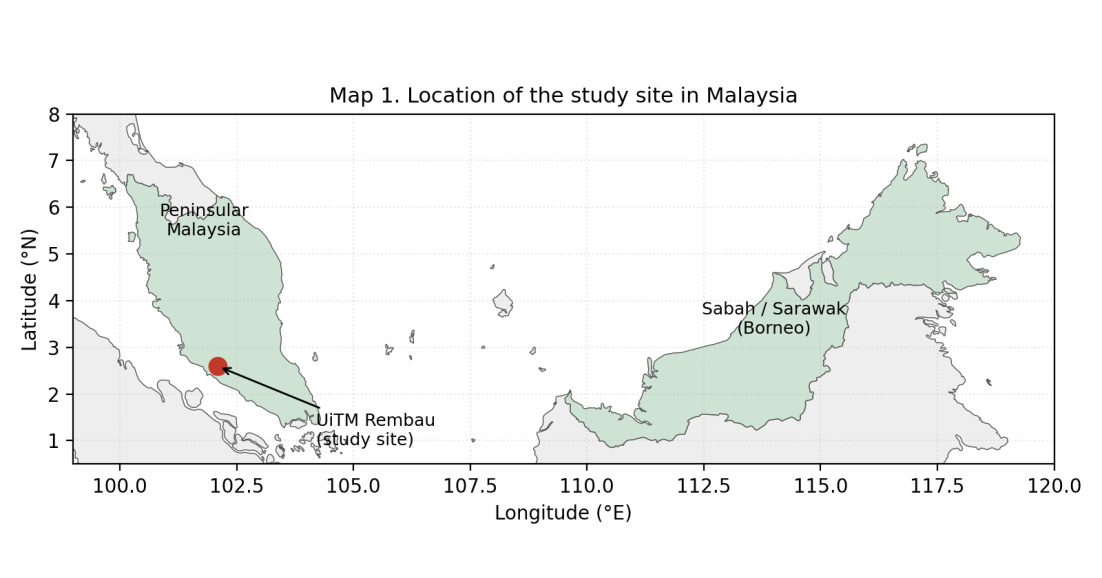
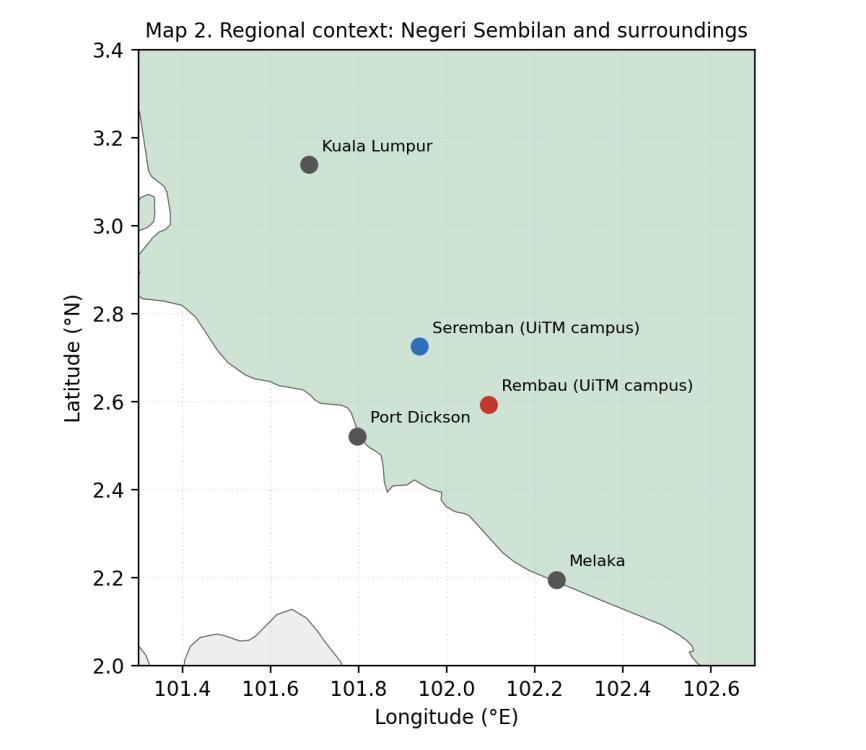
UiTM Negeri Sembilan Branch operates two campuses, Seremban and Rembau. The Rembau campus (Jalan UiTM Rembau, 71300 Rembau, Negeri Sembilan) hosts the Faculty of Information Science students surveyed here. Most students are young, connected through WhatsApp, Instagram and TikTok, and take part in campus activities such as gotong-royong, charity drives and club programmes, which allows both online and offline engagement to be observed.
1.4 Problem statement
Many young people share content about causes, yet it is unclear how far this sharing connects to action in their own community, and whether motives such as image concern or peer pressure reduce that link.
1.5 Research questions
- RQ1: How often do students share or post about social causes online, and which causes?
- RQ2: How many offline actions (donating, volunteering, attending events, signing petitions) do they take?
- RQ3: Is online sharing frequency associated with the number of offline actions?
- RQ4: What motives do students report, and are image-related motives associated with fewer offline actions?
1.6 Hypotheses
- H1: Online sharing frequency has at most a weak association with offline action.
- H2: Students with higher image concern take fewer offline actions than students with lower image concern.
- H3: A substantial share of frequent sharers take no offline action.
- H4: Informing others is the most common stated motive, ahead of image-related motives.
1.7 Significance
For students and student representatives, the study offers a mirror and practical habits. For lecturers and the faculty, it shows where information literacy and civic programmes can help. For the information profession, it links sharing behaviour to verification skills.
2. Literature Review
2.1 Slacktivism and performative activism
Slacktivism refers to low-effort online support that is thought to give a feeling of contribution without real impact (Morozov, 2011). Performative activism is related but focuses on display: support shown mainly to be seen. Gladwell (2010) contrasted the weak ties of social media with the strong ties that sustain high-risk activism.
2.2 Moral licensing and grandstanding
Moral self-licensing describes how a good deed can free people to behave less well afterwards, because they feel they have already shown their goodness (Merritt, Effron, & Monin, 2010). Applied here, posting about a cause might reduce the felt need to act. Moral grandstanding is the use of moral talk to impress others (Tosi & Warmke, 2016), which fits the “image” motive measured in this study.
2.3 Does online support help or replace action?
Evidence is mixed. Experiments suggest that when a first act of support is public and observable, people may later give less (Kristofferson, White, & Peloza, 2014), and that online expression can sometimes lower later contribution through moral balancing (Lee & Hsieh, 2013). Yet other work finds slacktivists can still add value to movements (Bozarth & Budak, 2017), and a review concludes that evidence that online action prevents offline action is mixed (Greijdanus et al., 2020).
2.4 Youth, social media and activism in Malaysia
Malaysian young people have used online video and social platforms to raise issues often neglected in mainstream media (Lim, 2013), and recent work on TikTok describes youth in Southeast Asia using it for activism despite risks and misinformation (Jalli, 2025). These studies show that online action can matter, which makes the question of when it connects to offline action more important.
2.5 The information angle
Sharing a cause is also information behaviour. Without checking sources, students may spread incomplete or false claims, which can harm the cause they want to support. Information literacy, a unit already taught in the programme, therefore offers a practical response.
2.6 Research gap
Few studies look at the link between online sharing and offline action among Malaysian students in a specific campus setting, and fewer treat verification and information behaviour as part of the picture.
2.7 Conceptual framework
- Online sharing frequency: may increase awareness, but may not lead to action.
- Motives (inform, image, peer pressure): shape whether sharing leads to action.
- Image concern: expected to be linked to fewer offline actions.
- Offline action (donate, volunteer, attend): outcome of interest.
- Verification habits: affect the quality of what is shared.
Figure 1. Proposed relationships.
3. Methodology
Design. Quantitative, cross-sectional survey with one open-ended item.
Sample. Students of the Faculty of Information Science, UiTM Negeri Sembilan, Rembau Campus, recruited by convenience sampling through class groups. Target n ≥ 50 [actual N = 50]. Survey open for 7 days.
Instrument. Google Forms questionnaire with sections on demographics, online sharing, offline action, motives, image concern (5 Likert items, 1 to 5) and verification habits. Items were kept neutral and avoid asking about political party membership or sensitive personal beliefs. Full instrument in Appendix A.
Variables
- Sharing frequency (ordinal): never, 1 to 2 times, monthly, or weekly or more, in the past 3 months.
- Offline actions (count): number of actions taken in the past 6 months (donation, volunteering, event attendance, petition, boycott, community work).
- Image concern (scale): mean of 5 Likert items.
- Motives (nominal): multiple response.
- Verification habit (ordinal): how often a source is checked before sharing.
Analysis plan
- Profile and frequencies: percentages, median, SD, to describe the data.
- Image-concern scale reliability: Cronbach’s alpha (target ≥ 0.70), to check consistency.
- H1, sharing vs offline action: Spearman’s rho, for ordinal and count data.
- H2, high vs low image concern: Mann-Whitney U, for two groups that are not normally distributed.
- H3, share of frequent sharers with no action: percentages, descriptive.
- H4, motives: frequencies, for multiple response.
Significance level α = 0.05. Software: Google Sheets or Excel for descriptives, JASP or SPSS for tests.
Ethics. Voluntary, anonymous, no identifying information; participants may withdraw at any time.
4. Results
PRACTICE COPY: every figure, table and statistic in Sections 4 to 6 is sample data for rehearsal. It is not from a real survey and must be replaced with actual results before this paper is submitted or published.
4.1 Respondent profile
Sample: 50 students; 56% female and 44% male; semester 2 (16%), semester 3 (30%), semester 4 (32%), semester 5 (22%); 60% living in hostel and 40% off campus.
4.2 Online sharing (RQ1)
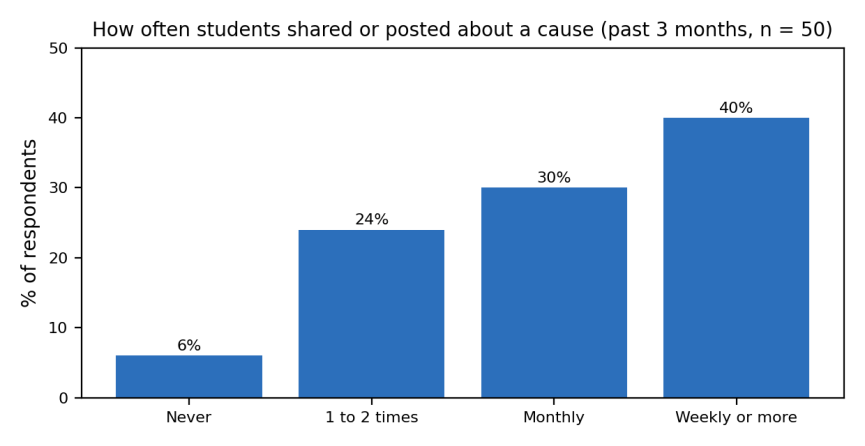
Sharing frequency in the past 3 months, with the number of students and the share of the sample:
- Never: 3 (6%)
- 1 to 2 times: 12 (24%)
- Monthly: 15 (30%)
- Weekly or more: 20 (40%)
Causes shared most often (multiple answers): humanitarian crises 72%, environment 40%, education and student welfare 34%, local community 30%, animal welfare 18%.
4.3 Offline action (RQ2)
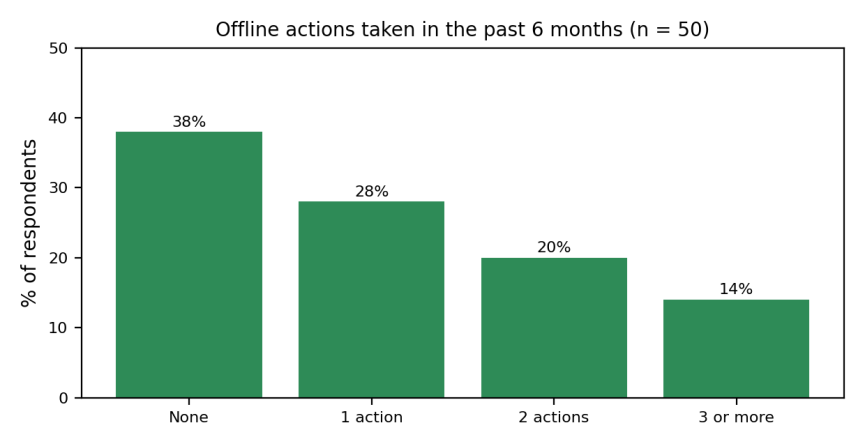
Offline actions in the past 6 months:
- None: 19 (38%)
- 1 action: 14 (28%)
- 2 actions: 10 (20%)
- 3 or more: 7 (14%)
4.4 Sharing and action (RQ3, H1, H3)
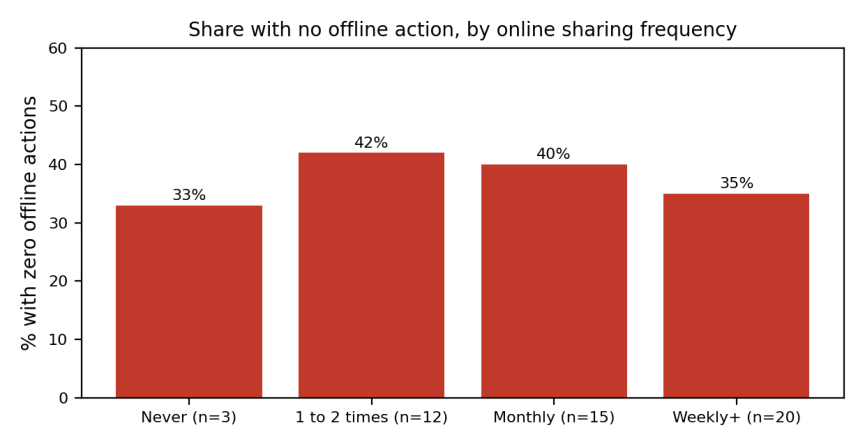
Spearman correlation between sharing frequency and number of offline actions: ρ = 0.17, p = 0.24, which is a weak and non-significant association. Among respondents who shared at least monthly (n = 35), 13 (37%) took no offline action in the past 6 months.
4.5 Motives and image concern (RQ4, H2, H4)
Reasons for sharing:
- To inform others: 66%
- To show I care or support: 54%
- Friends are doing it or it is trending: 46%
- Fear of being judged if I stay silent: 30%
- To start a discussion: 28%
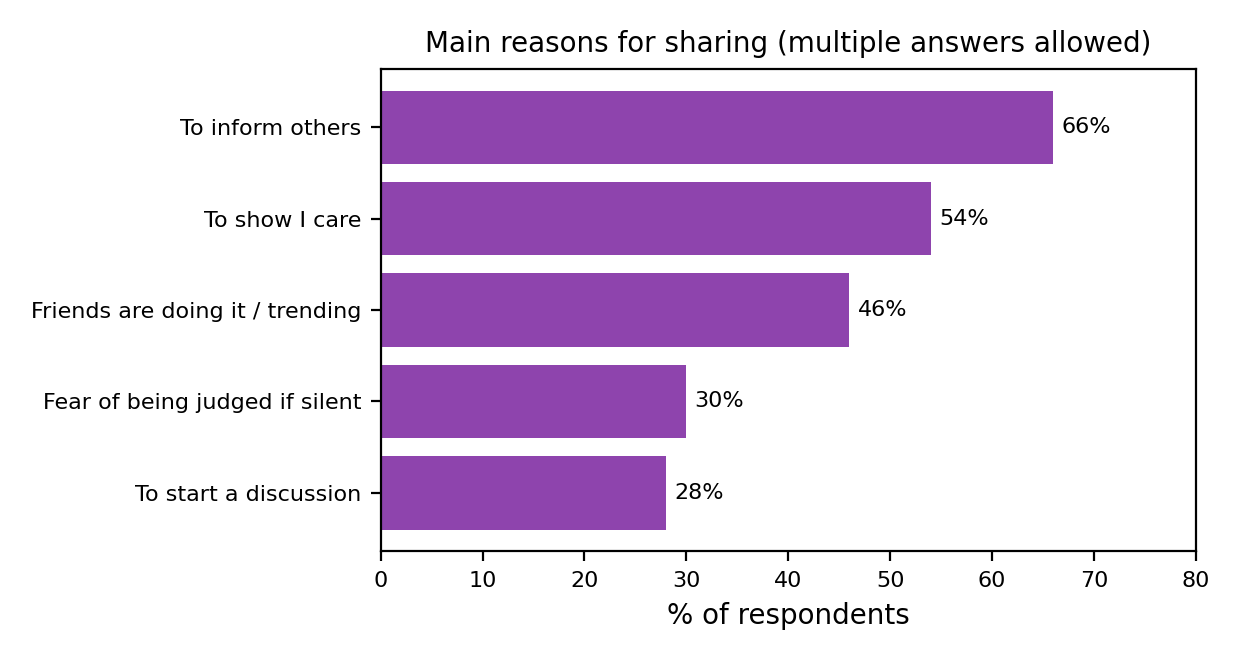
Image-concern scale: mean 3.1 (SD 0.9), Cronbach alpha 0.78. Students with high image concern (n = 24) had a median of 1 offline action, compared with 2 for students with low image concern (n = 26); Mann-Whitney U = 197, p = 0.03.
4.6 Hypothesis summary
- H1: Yes. ρ = 0.17, p = 0.24 (weak, non-significant).
- H2: Yes. U = 197, p = 0.03.
- H3: Yes. 37% of monthly-or-more sharers took no offline action.
- H4: Yes. Informing others was top (66%); showing care second (54%).
5. Discussion
5.1 Interpreting the pattern
In the sample data, frequent sharing was not clearly linked to more offline action, and over a third of regular sharers had done nothing offline. This fits the cautious view that online expression does not automatically become action (Gladwell, 2010; Kristofferson et al., 2014), but it does not show that sharing prevents action, because evidence is mixed (Greijdanus et al., 2020). The sample also shows that most students shared in order to inform others, which suggests many are sincere. Image concern was the clearer warning sign: students who cared more about how they appeared took fewer offline actions, consistent with moral grandstanding (Tosi & Warmke, 2016) and moral licensing (Merritt et al., 2010). These are associations in a small sample and should be tested with real data.
5.2 Everyday examples (illustrative scenarios)
- A disaster appeal goes viral. Performative version: repost the poster and move on. Meaningful version: verify the organisation, donate a small amount, tell two friends how.
- Campus welfare issue. Performative version: complain in a story. Meaningful version: send it to the student representative with details and a suggested fix.
- Environmental cause. Performative version: post a clean-up photo from someone else. Meaningful version: join one real gotong-royong event this month.
- A trending hashtag. Performative version: add the hashtag without reading. Meaningful version: read one reliable source first, then decide.
- Charity drive. Performative version: “like” the post. Meaningful version: volunteer for one shift or donate an item.
5.3 Why the gap exists
Three reasons are plausible. First, online support is cheap and visible, while offline action costs time and money. Second, social pressure rewards a quick post. Third, students may not know where or how to act locally. The practical lesson is to make the first real step small, specific and easy.
5.4 The “Share, Verify, Act” model
- Pause. Before sharing, ask whether you actually understand the issue.
- Verify. Check at least one reliable source (official body, reputable news outlet, library database).
- Share with purpose. Add what people can do, not only what to feel.
- Pick one real action. Donate, volunteer, attend, or contact the right person.
- Follow up. Record what you did and the result, so action becomes a habit.
5.4.1 For students
Set a “one real action per post” rule for causes you care about, and tell a friend so you stay accountable.
5.4.2 For student representatives and clubs
Share the action, not just the awareness: every call-to-action post should include a date, a place and one thing people can do.
5.4.3 For lecturers and the faculty
Add short activities on verifying viral content to information literacy lessons, and connect students with real community programmes in Rembau.
5.4.4 For the library and information professionals
Run workshops on fact-checking and source evaluation, and keep a simple guide to reliable fact-checking sites for students.
5.5 Limitations
Small convenience sample from one campus; self-reported behaviour that may be affected by social desirability; cross-sectional design, so associations only; and the offline action list may miss forms of help that students do not call “activism”. Future studies should use larger multi-campus samples, interviews, and compare Gen Z with older groups.
6. Conclusion
In the sample data, online sharing was only weakly linked to offline action, and image concern was associated with taking fewer actions. If real survey data show the same pattern, the main message is not that sharing is bad, but that sharing should be the first step rather than the last. Information literacy and small, specific calls to action can help young people turn concern into impact.
6.1 Recommendations
- Students: follow the “Share, Verify, Act” steps and pair every share with one concrete action.
- Student representatives and clubs: include a date, place and task in every call-to-action post.
- Lecturers: use real campaigns as case studies in information literacy and social media literacy classes.
- Faculty and library: host fact-checking workshops and publish a short guide to reliable sources.
- Researchers: compare self-reported action with verified attendance or donation records, and widen the sample.
References
Verify each entry against the original source before submitting, and format it to your publisher’s required style.
- Bozarth, L., & Budak, C. (2017). Is slacktivism underrated? Measuring the value of slacktivists for online social movements. Proceedings of the International AAAI Conference on Web and Social Media, 11(1), 484–487.
- Gladwell, M. (2010, October 4). Small change: Why the revolution will not be tweeted. The New Yorker.
- Government of Malaysia. (2019). Youth Societies and Youth Development (Amendment) Act 2019.
- Greijdanus, H., et al. (2020). The psychology of online activism and social movements: Relations between online and offline collective action. Current Opinion in Psychology, 35, 49–54.
- Jalli, N. (2025). Viral justice: TikTok activism, misinformation, and the fight for social change in Southeast Asia. Social Media + Society. https://journals.sagepub.com/doi/10.1177/20563051251318122
- Kristofferson, K., White, K., & Peloza, J. (2014). The nature of slacktivism: How the social observability of an initial act of token support affects subsequent prosocial action. Journal of Consumer Research, 40(6), 1149–1166.
- Lee, Y.-H., & Hsieh, G. (2013). Does slacktivism hurt activism? The effects of moral balancing and consistency in online activism. Proceedings of CHI 2013, 811–820.
- Lim, J. B. Y. (2013). Video blogging and youth activism in Malaysia. International Communication Gazette, 75(3).
- Merritt, A. C., Effron, D. A., & Monin, B. (2010). Moral self-licensing: When being good frees us to be bad. Social and Personality Psychology Compass, 4(5), 344–357.
- Morozov, E. (2011). The net delusion: The dark side of internet freedom. PublicAffairs.
- Tosi, J., & Warmke, B. (2016). Moral grandstanding. Philosophy & Public Affairs, 44(3), 197–217.
- UiTM Cawangan Negeri Sembilan. (n.d.). Kampus Rembau. https://nsembilan.uitm.edu.my/rembau/index.php
Appendix A: Survey instrument
- Consent: This anonymous survey is for a class research paper and takes about 5 minutes. Participation is voluntary. [ ] I agree to participate.
- Section A, about you. Q1 Semester: 1 to 6 or above. Q2 Gender: Female / Male / Prefer not to say. Q3 Residence: Hostel / Off campus.
- Section B, online sharing. Q4 In the past 3 months, how often did you share or post about a social cause? Never / 1 to 2 times / Monthly / Weekly or more. Q5 Which causes? (select all) Humanitarian crises / Environment / Education and student welfare / Local community / Animal welfare / Other. Q6 Why do you share? (select all) To inform others / To show I care or support / Friends are doing it or it is trending / Fear of being judged if I stay silent / To start a discussion / Other.
- Section C, offline action (past 6 months). Q7 Which did you do? (select all) Donated money or goods / Volunteered / Attended an event or programme / Signed a petition / Joined gotong-royong or community work / Boycotted a product / None.
- Section D, image concern (1 = strongly disagree, 5 = strongly agree). Q8 I think about how my post will make me look. Q9 I share things my friends would approve of. Q10 I feel judged if I stay silent on a trending issue. Q11 I post more when many people are posting about it. Q12 I like seeing how many people react to my posts.
- Section E, verification. Q13 How often do you check a reliable source before sharing? Always / Often / Sometimes / Rarely / Never.
- Section F, open-ended. Q14 What would make it easier for you to take real action?